Jeff Ament

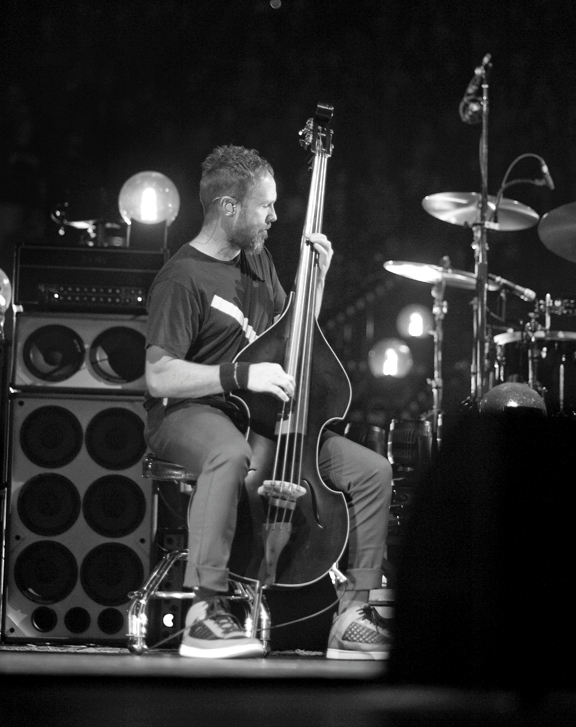
Jeff Ament
The story
Before Pearl Jam
In 1983 he came to Seattle with his band Deranged Diction, in which Bruce Fairweather also played. Stone Gossard and Jeff Ament were both in Green River, the band formed in 1984 around Mark Arm and Steve Turner that is now routinely named among the first to play the music later called grunge, and both left it at the end of 1987. Ament had been asked to join the new band in 1984; it put out the EP Come on Down in 1985, Dry as a Bone in 1987 on Sub Pop, and its one album, Rehab Doll, in 1988. By the published account the split came over a major-label deal, which Ament and Gossard wanted and Arm did not; on October 31, 1987, by the Green River article's date, the two and Fairweather said they wanted to quit.
Toward the end of the decade the two of them formed Mother Love Bone with Andrew Wood on vocals, Bruce Fairweather on guitar, and Greg Gilmore on drums. The band signed a major-label deal, with PolyGram by the published account, put out an EP, Shine, in March 1989, and recorded an album, Apple. Wood died on March 19, 1990, of a heroin overdose. He was 24, and Apple was days from its scheduled release; the album came out that summer, and Mother Love Bone did not go on without him. The months that followed are told in Where It Began.
The path into the band
For a time after Wood's death, by Wikipedia's account, Ament played with the Seattle band War Babies; it was Mike McCready who brought him and Gossard back together, and by the middle of 1990 the three were rehearsing. Chris Cornell of Soundgarden, who had written two songs in Wood's memory, asked Gossard and Ament to record them with him; that project became Temple of the Dog.
That summer, Gossard, Ament, and McCready recorded instrumentals, with Matt Cameron and the drummer Chris Friel sitting in for separate sessions, and five of the pieces went onto a cassette. They sent a copy to Jack Irons, the former Red Hot Chili Peppers drummer, in Southern California; Irons passed it in September 1990 to a singer he knew in San Diego. As Eddie Vedder has told it, he listened to the tape, went surfing, and recorded his own vocals over three of the instrumentals. He mailed the cassette back to Seattle, and Gossard and Ament listened, and invited him north.
Vedder arrived in Seattle in October 1990, and rehearsals began almost at once; Dave Krusen, a drummer from the Gig Harbor and Tacoma area whom Ament and Gossard had recruited after an audition, made five. The band needed something to call itself, and it took the name of a basketball player: Mookie Blaylock, then a point guard for the New Jersey Nets. Ament has told the story of how it started, with the band sending out a tape and a Mookie Blaylock trading card tucked into the case. On Monday, October 22, 1990, the five played their first show together at the Off Ramp Cafe, as an opening act, Ament on bass; the night is told in The First Show.
Contributions and recording credits
In November and December 1990, Gossard, Ament, and McCready recorded at London Bridge Studio with Cornell and Matt Cameron as Temple of the Dog; the album, produced by the band with Rick Parashar of the studio, came out on April 16, 1991, through A&M Records. On that record he is credited with bass and with its art direction, art design, and photography, and "Pushin Forward Back" is credited to Ament and Gossard.
In March and April 1991 the band recorded Ten at London Bridge Studio with Parashar, whom Gossard and Ament had asked to co-produce and engineer it, by Wikipedia's account. On the album he is credited with fretless bass and 8-string bass, and with 12-string bass on "Why Go," "Jeremy," and "Deep." The music of "Why Go" and "Jeremy" is credited to him alone; "Oceans," "Garden," "Deep," and "Release" carry his name among their composers, and all the lyrics are Vedder's.
The hidden instrumental that opens and closes the disc, "Master/Slave," is built on a fretless bass line, Wikipedia's article on the album says, and its Japanese bonus-track listing credits the piece to Ament and Vedder. He is also credited with the album's art direction and concept, and the wood cut-out of the band's name on the cover, photographed by Lance Mercer, was constructed by him, the article says.
Projects and interviews
Temple of the Dog, by Wikipedia's account, formed in Seattle in 1990 as Cornell's tribute to Wood, and "Hunger Strike" became what that account calls its "breakout single." The band played a set of its own, without Vedder, at the Off Ramp on November 13, 1990, and played again at the Moore in December, at RKCNDY on August 3, 1991, at the Foundations Forum, and at the Palladium.
Two transcribed sources carry his own words on this period. On KISW on April 14, 1991, the Sunday before the Temple of the Dog album came out, Ament called the project "a really good thing at the time" for him and Gossard that put them in a "band situation where we could play and make music," as Five Horizons transcribes it. The Bass Player interview of April 1994, as the same site transcribes it, looks back on Ten from outside the window. The account ends with 1991, the last year the band's early story has been followed show by show; what came after is not told here.
Musical timeline
Before Pearl Jam: the record
Album credits
Associations
Selected concerts
- The First Show
bass at the first show, October 22, 1990
- Saturday at the Moore
one of three of the band on the Temple of the Dog record, December 22, 1990
- Nine Songs in Los Angeles
the lineup from the autumn, February 7, 1991
- The Last Show as Mookie Blaylock
the last show under the old name, and the KISW announcement with Vedder eight days later
- Back at the Off Ramp
the first show as Pearl Jam, after the album was recorded, May 17, 1991
- The Wrap Party
Citizen Dick, and Dave Krusen's last show, May 25, 1991
- The Fourth at RKCNDY
named with Vedder, Gossard, and McCready beside a new drummer, July 4, 1991
- Eleven Songs at JC Dobbs
Mother Love Bone named as the band before this one, July 12, 1991
- Monday in Providence
the courts after soundcheck, July 15, 1991
- Filmed at RKCNDY
the Temple of the Dog mini reunion, August 3, 1991
- Outdoors at the Mural Amphitheatre
his basketball thrown into the crowd, August 23, 1991
- Monday at the I-Beam
over for a better look at a T-shirt, September 30, 1991
- A Year Ago Tomorrow
in the captioned photographs with Cornell and Cantrell, October 6, 1991
- Thursday at Trees
full harmonies on "Garden," October 10, 1991
- Half-Full at the Vatican
at the back with Doug Pinnick, unrecognized, October 11, 1991
- Basketball in Ames
the nickname, October 19, 1991
- This Is Seattle
the Cleveland show whose photographs, as the Pearl Jam Concert Chronology captions them, name him three times, October 26, 1991
Sources & thanks (7)
- Five Horizons. Concert chronology 1990-1991. (opens in a new tab)
- Pearl Jam. Ten. Epic Associated / Sony Music Entertainment, catalog # ZK 47857 (Compact Disc), 1991.
- Pearl Jam. Band. pearljam.com (checked 2026-09-20). (opens in a new tab)
- Sub Pop Records. Green River. (opens in a new tab)
- Temple of the Dog. Official site. (opens in a new tab)
- Montana Skatepark Association. About. (opens in a new tab)
- Rock and Roll Hall of Fame. Inductees: Pearl Jam (2017). (opens in a new tab)